What is likely to change if our countries and societies become safer for women and children?
Women would have greater freedom to move, study, work, and participate in public life without their
choices being constrained by the threat of violence. Children would be less exposed to the effects of
violence within their homes and communities. Families, public systems and economies would carry
fewer of the costs that violence creates. Some global evidence demonstrates these connections. A
macroeconomic study of Ghana estimated that violence against women resulted in losses equivalent
to about 0.94% of GDP, describing this not as a one-time cost but as a continuing loss from the
economy.1 Evidence from Peru found that expanding women’s access to justice reduced genderbased violence and was accompanied by improvements in children’s school attendance and test
scores.2 These studies point to a broader possibility: making women and children safer does not
benefit survivors alone. It can increase participation, improve human potential and strengthen the
societies in which they live.
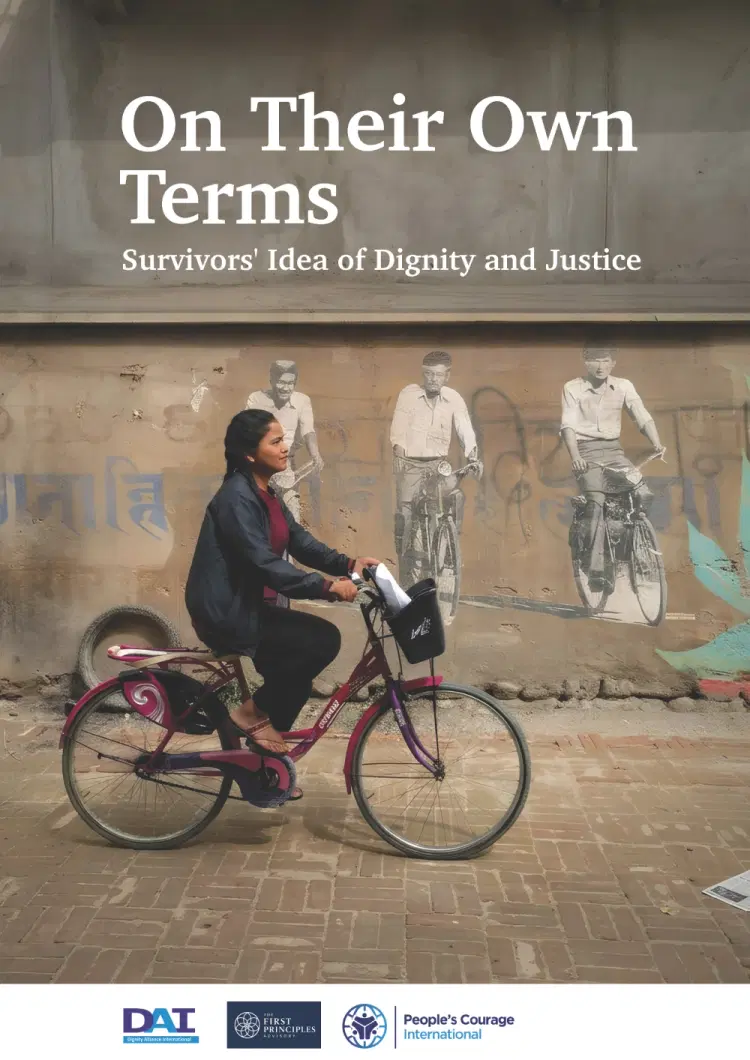
The research that led to this report, On Their Own Terms: Survivors’ Idea of Dignity and Justice,
seeks to answer this question: What needs to change for this to become a reality? 168 survivors
of sexual violence, 160 family members, and 192 criminal justice system actors, caseworkers and
community workers from across Bangladesh, India, Indonesia, Nepal, the Philippines and Sri Lanka
articulated what justice meant to them, what helped them seek it, and what made it harder. What
emerges is that the meanings of justice extend beyond reporting, prosecution or conviction: justice
is also safety, dignity, acknowledgement, healing, financial security, reproductive choice, being able
to continue with education or work, and having the support required to rebuild their lives.
Survivor testimonies point to the need for a survivor-centric system that is both responsive and
accountable: where laws, institutions, budgets, services and community responses are designed
around the survivor’s safety, dignity, autonomy, access to support and ability to recover, rather than
the convenience of institutions. It requires systems to change how they investigate, coordinate,
allocate resources, deliver services and measure outcomes in ways that respond to survivors’
actual circumstances – including known perpetrators, dependency, family or community pressure,
delayed reporting and economic constraints. Legal, medical, psychosocial, protection and financial
support should be accessible, connected and sustained throughout a survivor’s journey. Prevention
requires changing the culture, education, social norms and beliefs that normalise violence, protect
perpetrators, blame or silence survivors, and make the denial of safety and justice socially acceptable.
In this sense, survivor-centricity is not only about how an individual survivor is treated; it is about
reforming the system to prioritise safety, meaningful choice, recovery and accountability.
Download di sini.